The samples were prepared by Ben Roszyk of Trudy Kriven's lab, and tested by Bo Song of
Wayne Chen's lab. The results are intriguing, and could be used to support the existence of
phase-transformation toughening for small strain-rate applications, in that the failure
mechanism is not catastrophic. However, this requires many more trials on different samples.
Without a toughening mechanism, the onset of cracks at the surface (the surface is typically the
weak point of all samples) immediately leads to catastrophic failure, as the cracks propagate
through the sample, effectively instantaneously. If crystallites, in a high-pressure phase, are
embedded in the brittle matrix, then as a crack begins to propagate, nearby crystallites
experience a decrease in their confining pressure. This leads them to expand, thereby
constricting the propagating crack. The questions involved in determining the feasibility of this
mechanism are many, making this a good system to study experimentally. Two questions are
"how small must the crystallites be?", and "how densely must they be represented?", in order to
respond quickly enough and effectively enough for a given mechanical application.
Wayne Chen's lab. The results are intriguing, and could be used to support the existence of
phase-transformation toughening for small strain-rate applications, in that the failure
mechanism is not catastrophic. However, this requires many more trials on different samples.
Without a toughening mechanism, the onset of cracks at the surface (the surface is typically the
weak point of all samples) immediately leads to catastrophic failure, as the cracks propagate
through the sample, effectively instantaneously. If crystallites, in a high-pressure phase, are
embedded in the brittle matrix, then as a crack begins to propagate, nearby crystallites
experience a decrease in their confining pressure. This leads them to expand, thereby
constricting the propagating crack. The questions involved in determining the feasibility of this
mechanism are many, making this a good system to study experimentally. Two questions are
"how small must the crystallites be?", and "how densely must they be represented?", in order to
respond quickly enough and effectively enough for a given mechanical application.
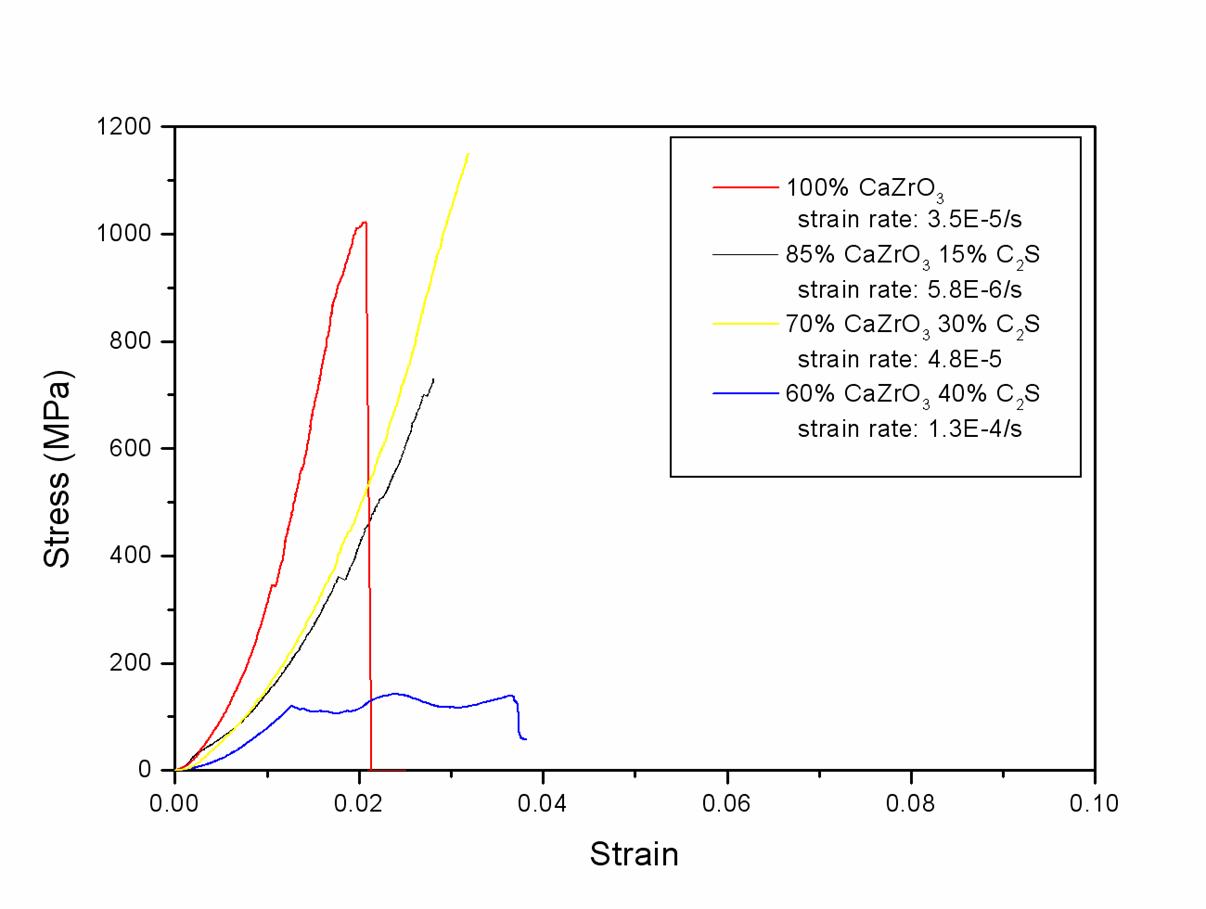
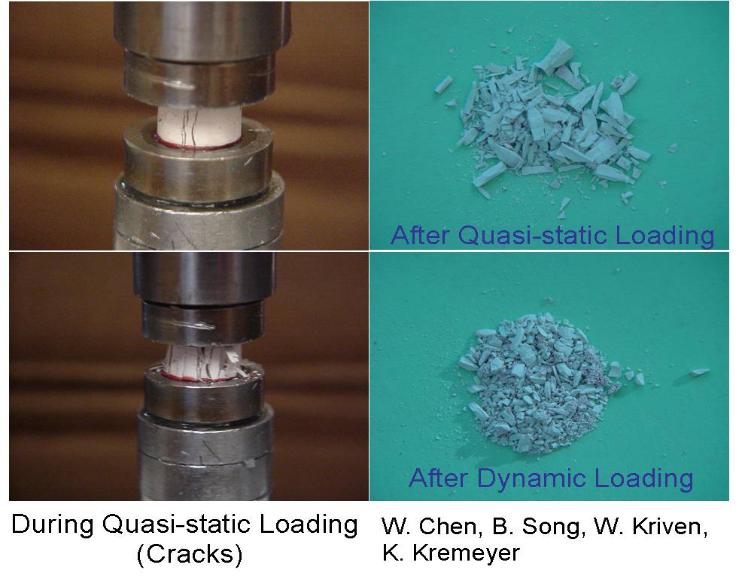
It was interesting to note that the 60% CaZrO3 sample maintained strength well into the onset
of failure during the quasi-static test. Visible cracks had formed on the surface of the sample
when the stress-strain curve "went flat".
of failure during the quasi-static test. Visible cracks had formed on the surface of the sample
when the stress-strain curve "went flat".
 |
| |
 |
| |
 |
| |
 |
| |
 |
| |
 |
Click to enlarge thumbnails
| CaZrO3 toughened with Ca2SiO2 |

Quasi-Static Stress-Strain relation of
CaZrO3 toughened with Ca2SiO2
CaZrO3 toughened with Ca2SiO2
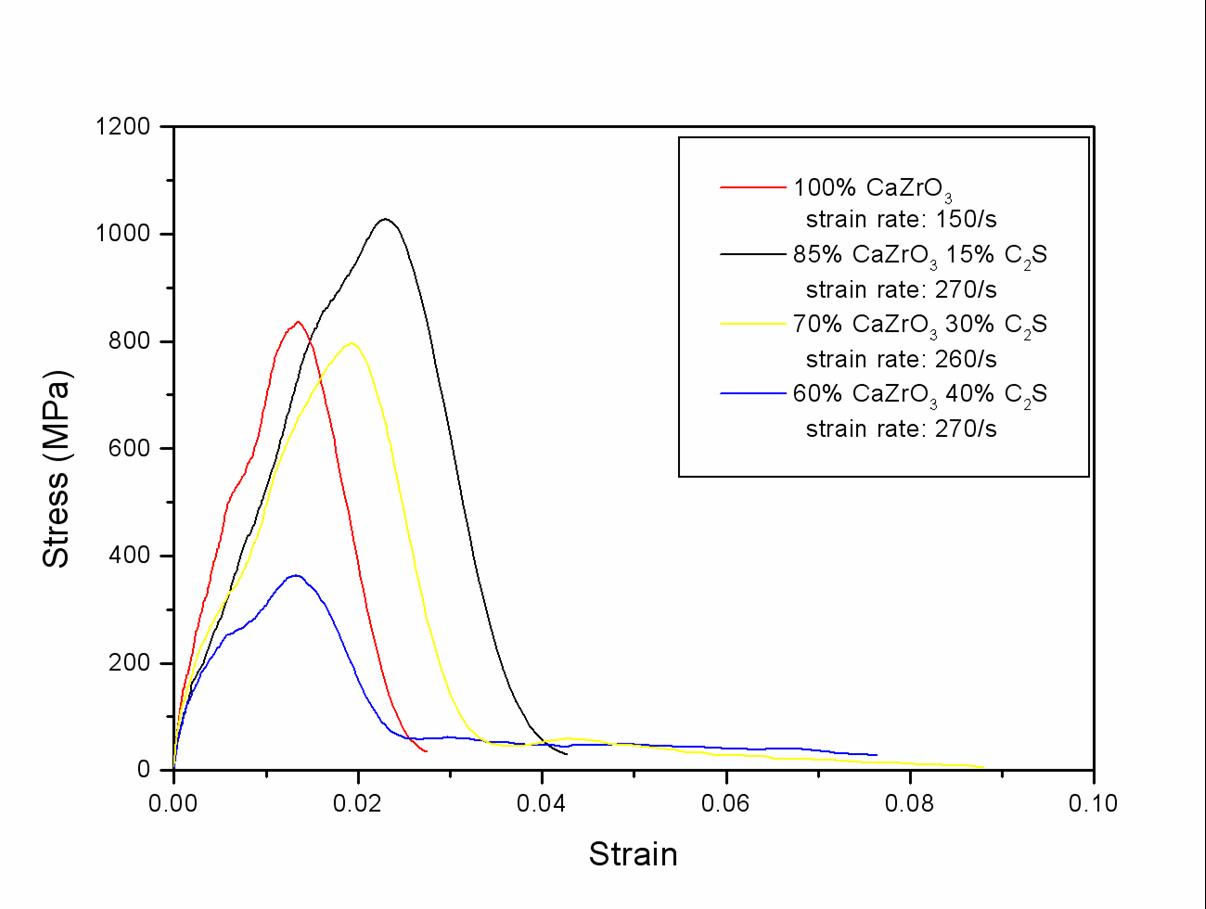
Dynamic Stress-Strain relation of CaZrO3
toughened with Ca2SiO2
toughened with Ca2SiO2