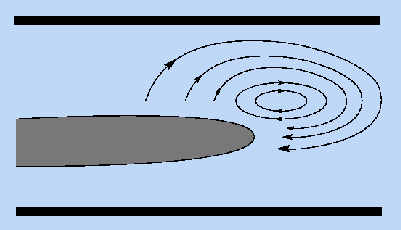
SIDE VIEW
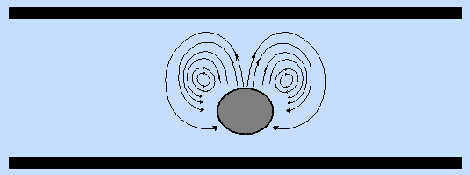
FRONT VIEW
The schematic diagrams shown here are of dendritic growth in a quasi 2-D chamber. The
fluid flow is driven by both shrinkage (which occurs during solidification from the melt) and
gravity-driven buoyancy of the low-density fluid, which remains after the dendrite solidifies.
fluid flow is driven by both shrinkage (which occurs during solidification from the melt) and
gravity-driven buoyancy of the low-density fluid, which remains after the dendrite solidifies.
 |  |  |  |  |
 |
| |
 |
| |
 |
| |
 |
| |
 |
| |
 |
| |
 |
| |
 |
| |
 |
Aerodynamics
- PM&AM Research's fluids capabilities range from microfluidics to hypersonic flow.
Incorporating reactive species and inhomogeneous initial conditions into these flows allows
us to study phenomena with a variety of applications.
Significant Drag Reduction indicates that our method can revolutionize supersonic and
hypersonic flight.
- Drag Reduction
- Our drag reduction technology presents the possibility to eliminate more than 90% of the drag
when flying at supersonic/hypersonic speeds. The process also saves energy, allowing not only
faster but also more efficient flight. Further benefits are reduced emission and noise from
supersonic/hypersonic platforms.
- 2006 AIAA Journal Paper
- 2004 AIAA Fluid Dynamics Conference Paper
- 2004 Plasma Dynamics & Lasers Conference Paper
- Supersonic/Hypersonic Drag Reduction and Flow Control Patent
- Subsonic Drag Reduction and Flow Control Patent
- Supersonic/Hypersonic Control
- Our hypersonic control technology is closely linked to our drag reduction technology. The
control is achieved quite simply by reducing the drag in the direction in which we would like
the vehicle to fly. This approach allows the entire airframe to be used as the control surface,
obviating the need for vulnerable high-speed flaps that require strong actuators and
mechanisms. The control extends to separation from supersonic/hypersonic platforms, as well
as for ensuring that the vehicle is aligned with the direction of flight.
- Internal Flows
- Internal flow applications are typically governed by shock dynamics and chemical kinetics,
both of which can be positively affected with dramatic effect by the energy addition we have
patented.
- Shockwave Dynamics and Control
- One of our main concerns is the control of shock waves. This interest has grown from our
demonstration that the effect of ionization on shock propagation is primarily a result of the
heating undergone by the gas during the ionization process (AIAA-2000-2700, Physica D 163
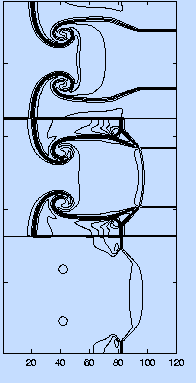
(2002) 150-165). The contour plots to the left are of entropy (top), density (middle), and
pressure (bottom). A shock wave is moving in a shock-tube to the right, followed by a contact
discontinuity, which is heavily distorted due to the Richtmyer-Meshkov Instability. The
quiescent gas to the right of the shock wave has an inhomogeneous temperature profile
transverse to the direction of propagation. Along the axis of the shock-tube, the gas is hotter,
which makes it less dense. Near the shock-tube walls, the gas is cooler, which makes it more
dense. This results in a bowing of the shock and other very interesting fluid dynamics.
- Vorticity
- In all of our fluid dynamics problems, we investigate vorticity generation and the resulting
vortex dynamics to help us understand and manipulate phenomena of interest (AIAA 99-0871).
This is one of the many connections between our group and the mathematics programs at the
University of Arizona and the University of Warwick.
- Convection in Solidification Problems
- In our experimental and numerical studies of dendritic growth and solidification of NH4Cl
(aq), it has been necessary to investigate the fluid flow surrounding the dendrites.


| Aerodynamics |