Materials Science and Engineering Project
- One of the PM&AM Research team’s greatest strengths is its background in solid-state and
condensed matter physics. In combination with a strong background in materials science
and engineering, we can develop new materials and devices, as well as investigate and model
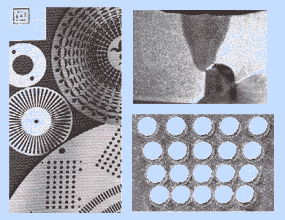
unknown properties/responses in existing materials. Our current efforts employ Terawatt
lasers for micro-machining, and to induce damage. We are also developing this technology
to treat surfaces and create novel interfaces/joins. One of our past programs involved
drilling Nickel-based alloys (such as Inconel and Hastelloy) with high-energy, ultrashort,
UV laser pulses. Further overlap with our lasers/optics emphasis occurs in our directed
energy and remote sensing programs.
In developing high-performance ceramic armor, as well as potential commercial products,
we have been collaborating with Professors Wayne Chen and Trudy Kriven to test both
quasi-static and high-strain-rate properties of transformation-toughened ceramics. This
work will allow us to better exploit the strength of ceramics, by mitigating their inherent
brittleness.
Our current effort is to use Terawatt lasers for micro-machining, and to induce damage. We
are also developing this technology to treat surfaces and create novel interfaces/joins. One
of our most recent projects involved drilling Nickel-based alloys (such as Inconel and
Hastelloy) with high-energy, ultrashort, UV laser pulses. Further overlap with our
lasers/optics emphasis occurs in our directed energy and remote sensing programs.
In developing high-performance ceramic
armor, as well as potential commercial
products, we have recently been collaborating
with Professors Wayne Chen and Trudy Kriven
to test both quasi-static and high-strain-rate
properties of transformation-toughened
ceramics. This work will allow us to better
exploit the strength of ceramics, by mitigating
their inherent brittleness.
armor, as well as potential commercial
products, we have recently been collaborating
with Professors Wayne Chen and Trudy Kriven
to test both quasi-static and high-strain-rate
properties of transformation-toughened
ceramics. This work will allow us to better
exploit the strength of ceramics, by mitigating
their inherent brittleness.
 |
| |
 |
| |
 |
| |
 |
| |
 |
| |
 |
| |
 |
| |
 |
| |
 |
Additional past projects:
- SOLIDIFICATION
- A major thrust for us has been the experimental, computational, and theoretical investigation of
solidification, and the accompanying interface kinetics and convective flow. This project has resulted in
the development of a generalized CELLULAR AUTOMATA SOLIDIFICATION CODE which
incorporates competing crystalline anisotropies, and has demonstrated the correct behaviour in all of the
growth regimes, including a cross-over from slow dendrites in the direction to "fast" dendrites in the and
directions. These dynamics have proven to be key in the recrystallization of the energetic propellant CL-
20 (China Lake-20, which is of interest primarily to the China Lake Naval Air Warfare Center Weapons
Division, and Thiokol Propulsion.
- FABRICATION AND CHARACTERIZATION OF UNSUPPORTED C60/C70 FILMS
- Working together with Professor Don Huffman of the University of Arizona Physics Department , we
developed a novel method of lifting and holding unsupported films of C60/C70 to allow characterization
of their various spectra. This work has also led to our interest in using these large molecules to nucleate
diamond-like thin films in various deposition applications.
- SUPERCONDUCTORS
- Working together with the Walther Meissner Institut in Garching, Germany, we helped map out the
critical region of the ternary phase diagram for YBa2Cu3O6+x. We have also implemented different
models of magnetic flux penetration into type II superconductors for the Mathematics and Computer
Science Division of Argonne National Laboratories.
- WHISKER GROWTH
- In certain situations, thin films produce whiskers out of the plane to relieve compressive stresses. We
have contracted with several industrial partners to help them solve whisker growth problems causing
failure in critical systems, sensors, and detectors.
- PLASMA IMMERSION ION IMPLANTATION
- Working in the Plasma Division at Los Alamos National Laboratory we developed a three-axis magnetic
flux meter, fully encased in ceramic and glass to withstand the harsh environment in the plasma chamber.
We also developed diagnostics to characterize the growth of oxide and nitride interfaces and the
associated surface damage.
- ACOUSTIC AND VIBRATIONAL PROPERTIES OF DISORDERED MATERIALS
- Working together with Professor John Kieffer of the Materials Science and Engineering Department and
Materials Research Laboratory at the University of Illinois at Urbana Champaign, we probed different
disordered materials to determine the effect of the disorder on their vibrational and acoustic modes. - The main method was Brillouin scattering, where it was possible to measure the photons that were
scattered inelastically from the different vibrational modes in the solid. In a perfectly homogeneous
solid, these modes are phonons which travel at the designated speed of sound. Even in inhomogeneous
solids, for very low frequency vibrations, the solid looks homogeneous and sustains phonon modes
traveling at a given effective speed of sound. - However, as the phonon wavelengths decrease with increasing frequency and the inhomogeneities
become more significant, the vibrational modes deviate further and further from phonon states, and
eventually localize. This was further investigated using the neutron scattering facility at Argonne National
Laboratory. - The primary materials investigated were glass-ceramics and silica aerogels (supplied by the Chemistry
and Materials Science Division of Lawerence Livermore National Laboratory).

| Materials Science and Engineering Projects |