| Optics Projects |
The word "optics" is used here to encompass a large range of the electromagnetic spectrum. PM&AM
Research uses materials diagnostics in the following spectral ranges:
To probe fast phenomena and develop fast sensors, the Advanced Photon Source is used at Argonne
National Laboratory.
For lower frequencies, we also designed, built, and calibrated a special sensor for use in the Plasma
Division of Los Alamos National Laboratory, to measure the full three-dimensional oscillatory
magnetic field in an RF, inductively generated plasma. The information from this sensor was used to
infer the oscillating electric field.
We are continually pressing to develop femto-second, terawatt laser systems for applications in Flow
Control and Materials Science. Our modelling and experimental capabilities are both greatly enhanced
by our strong ties to the University of Arizona's Optical Science Center and the Arizona Center for
Mathematical Sciences.
Directed Energy and Remote Sensing
Our directed energy program has concentrated primarily on the exploration of filamenting laser pulses.
These pulses can be used, not only to damage a target, but also as an illumination source for a variety of
spectroscopic techniques.
Research uses materials diagnostics in the following spectral ranges:
- IR
- Optical
- UV
- X-ray
- and those obtainable with electron microscopes.
To probe fast phenomena and develop fast sensors, the Advanced Photon Source is used at Argonne
National Laboratory.
For lower frequencies, we also designed, built, and calibrated a special sensor for use in the Plasma
Division of Los Alamos National Laboratory, to measure the full three-dimensional oscillatory
magnetic field in an RF, inductively generated plasma. The information from this sensor was used to
infer the oscillating electric field.
We are continually pressing to develop femto-second, terawatt laser systems for applications in Flow
Control and Materials Science. Our modelling and experimental capabilities are both greatly enhanced
by our strong ties to the University of Arizona's Optical Science Center and the Arizona Center for
Mathematical Sciences.
Directed Energy and Remote Sensing
Our directed energy program has concentrated primarily on the exploration of filamenting laser pulses.
These pulses can be used, not only to damage a target, but also as an illumination source for a variety of
spectroscopic techniques.
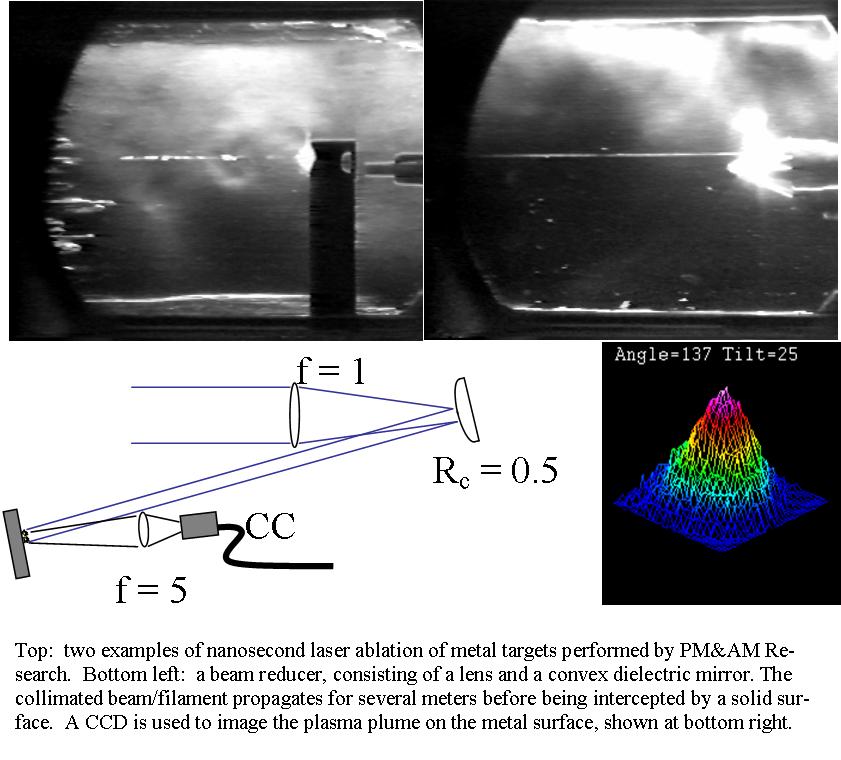
For infrared pulses, the conical emission of a filament can illuminate the atmosphere or medium in
the filament's immediate area. This can provide spectroscopic backscatter information on airborne
pollutants and contaminants. Comparted to the IR, UV pulses are considered to waste much less
energy through generating secondary light during propagation. As a result, they can deliver much
more of their energy to a target. This energy can be used to induce structural or optical damage, or to
ablate an ionized plume of material, whose spectroscopic signatures can be used to identify the
target material. The broad spectrum emitted from the ablation can also serve as the illumination for
more conventional spectroscopic techniques. One notable characterization technique is fluorescence
spectroscopy, along with the related phosphorescence. The phosphorescent technique can be
utilized, by time-gating the "fluorescent" output.
the filament's immediate area. This can provide spectroscopic backscatter information on airborne
pollutants and contaminants. Comparted to the IR, UV pulses are considered to waste much less
energy through generating secondary light during propagation. As a result, they can deliver much
more of their energy to a target. This energy can be used to induce structural or optical damage, or to
ablate an ionized plume of material, whose spectroscopic signatures can be used to identify the
target material. The broad spectrum emitted from the ablation can also serve as the illumination for
more conventional spectroscopic techniques. One notable characterization technique is fluorescence
spectroscopy, along with the related phosphorescence. The phosphorescent technique can be
utilized, by time-gating the "fluorescent" output.
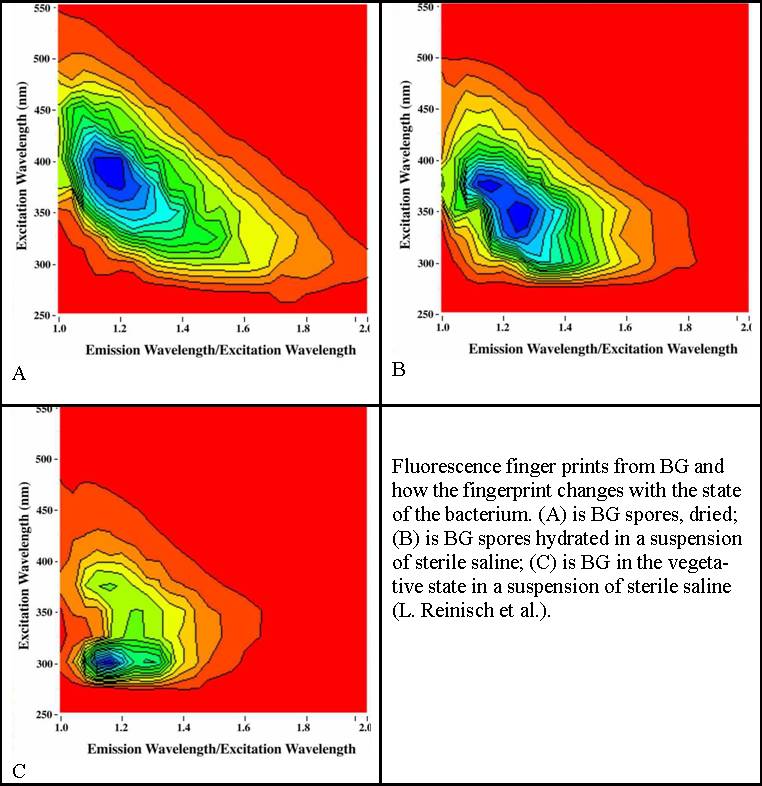
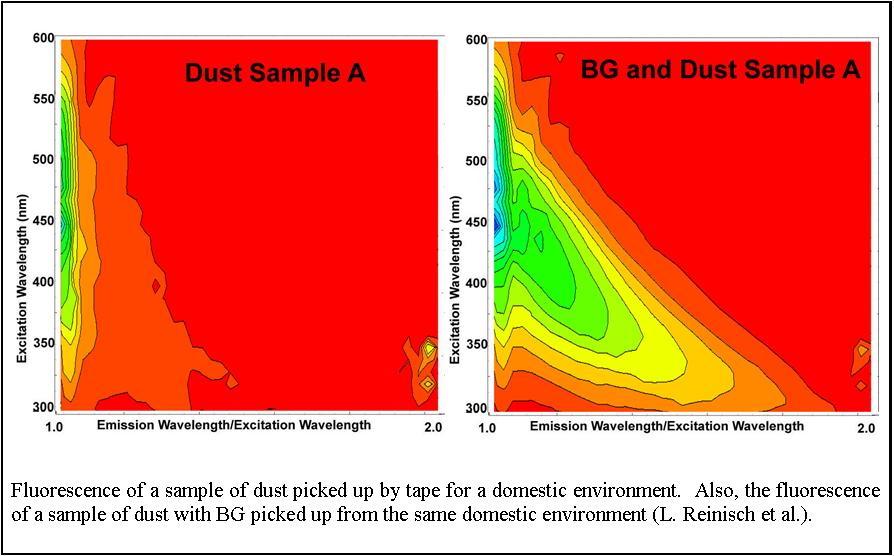
"BG" stand for Bacillus Globigii, and it serves as the most common simulant for Bacillus Anthracis
(Anthrax). We are currently developing a stand-off method to identify this and related bacteria.
(Anthrax). We are currently developing a stand-off method to identify this and related bacteria.
 |
| |
 |
| |
 |
| |
 |
| |
 |
| |
 |
| fluorescence spectra of Anthrax simulants in different states. Click Thumbnail to Enlarge |
| fluorescence spectra of an Anthrax simulant compared to the fluorescense of a sample background. Click Thumbnail to Enlarge |
| filaments for directed energy and material identification. Click Thumbnail to Enlarge |